MEI: Matrilineal Exogamous Institution- Mother
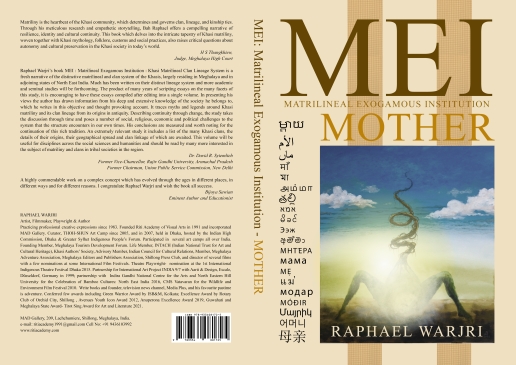
KHASI MATRILINEAL CLAN LINEAGE SYSTEM
The Khasi people hold their matrilineal clan lineage in high esteem as a sacred tradition, although its perceived sanctity has waned among the urban middle class, influenced by prevailing patriarchal norms. This suggests a need for a reevaluation of matriliny within the Khasi context to ensure a more accurate definition that reflects clan relationships. In the Khasi tradition, the roles of the maternal and paternal figures in human reproduction are highly respected, with the maternal line playing a central role in family and clan identity. The father belongs to his mother's clan, whereas his wife and children belong to the maternal clan. This system underscores the importance of mothers and maternal uncles in maintaining the family's honor and integrity. Ancestry is traced through the mother, with the umbilical cord symbolizing the life connection within the clan. The Khasi creation myth, centered around U Lum Sohpetbneng or the Mount of Heavenly Navel, speaks to the origin of humanity, where souls are believed to have descended from heaven via a Golden Vine, highlighting a universal and inclusive worldview. This narrative underlines the profound significance of maternal lineage in Khasi society, portraying a deeply rooted belief in the unity and continuity of humankind.
The genesis myth of humankind according to Khasi tradition forms the cornerstone of their matrilineal clan lineage system, a tradition predating the advent of organized religion and its associated practices such as incantations, libations, rituals, and ceremonies, which permeate every aspect of their social, cultural, and political life. Anthropological theories suggest that matriliny was the original social structure of human societies, grounded in the undeniable bond and immediate companionship between a mother and her children, nurtured through birth and early life sustenance. In ancient times, children depended solely on their mothers for emotional and physical support until they gained independence, a testament to the enduring nature of maternal bonds.
Despite the prevalent shift towards patriarchal systems in modern societies globally, the matrilineal system's resilience is evident across various communities that continue to uphold these traditions, often in the face of dominant patriarchal pressures. This is markedly visible among the Minangkabou people of Indonesia, a predominantly Muslim community that maintains its matrilineal culture with remarkable endurance and commitment, challenging stereotypical views on gender roles within Islamic societies.
Matrilineality persists across the world, from the Musuo in China, the Akan, Ashanti, and Tuareg in Africa, to the Serer of Senegal, Gambia, and Mauritania, and extends to the Minangkabou of Indonesia, as well as the Khasi and Garo in India and Bangladesh. These communities demonstrate a steadfast adherence to matrilineal principles despite the global trend towards patriarchal systems. Some societies have transitioned to patriarchal systems or are in the process of doing so, yet many continue to robustly maintain their matrilineal lineage, showcasing the diversity and resilience of human social structures.
Social change occurs in a manner that aligns with the unique circumstances and needs of each community, often without foreseeing the long-term implications for ethnic identity preservation. Therefore, it's crucial to consider the changes happening within a generation's approximate timeframe when contemplating future alterations. This understanding allows for the restoration or modification of societal norms while adapting to contemporary challenges. When different communities coexist, assimilation can occur harmoniously or through conflict, particularly when one group seeks supremacy, leading to suppression of the vulnerable and subsequent dissent. Factors like migration and refugee influx may shift social dynamics, potentially leading to resistance and conflict among communities. Ethnic assertion during periods of social harmony may further exacerbate tensions. To safeguard a community's ethnic identity, it's essential to delve into its history and mythology, as seen in the case of the Khasi community's matrilineal customs rooted in their creation myth.
In the universe, and potentially the multiverse, the concept of Mother Earth transcends our planet, embodying the essence of creation itself. Contrary to the belief that soil, an element of the earth, is exclusive to our world, it pervades the cosmos, marking its presence across numerous celestial bodies. This perspective is deeply rooted in Khasi mythology, which venerates Earth as the progenitor of all life, suggesting that the very fabric of existence weaves through her. According to Khasi lore, Earth's gestation period spanned eons, during which she transformed, birthing stones from her own essence, symbolizing the genesis of life from the Earth's womb. This narrative posits Earth and stone as fundamental binaries, catalyzing the emergence of primary elements — the sun, moon, air, water, and fire—vital forces that orchestrated the dawn of life.
The interplay of these elements, underpinned by the influences of sunlight, moonlight, air, water, and fire, heralded the sprouting of flora, setting the stage for nature's tableau. Vegetation thrived, cycling through growth, bloom, and decay, wherefrom new seeds sprang forth, diversifying into a plethora of plant species. This cycle of life, from decay to rebirth, mirrors the evolution of life forms, from simple organisms to the complex tapestry of life encompassing reptiles, fish, birds, amphibians, mammals, and eventually, humans.
Humanity, within this cosmology, assumes the role of steward, entrusted with the guardianship of nature's myriad forms, each reliant on the other for survival, thereby maintaining ecological equilibrium. The Khasi matrilineal tradition draws inspiration from this creation myth, structuring the family unit as a microcosm of the cosmic order: the mother as Earth, the father symbolized by stone, and their offspring embodying the primary elements, with a distinct matrilineal lineage that positions females as the bearers of life's continuance, save for the moon, deemed male.
In this familial construct, the sun is the eldest daughter, the moon, the son, succeeded by air and water, with fire, the youngest daughter, bearing a unique responsibility. The myth culminates in the demise of Mother Earth, where the duty of last rites falls upon her children. The tale recounts how, except for fire, none could fulfill this sacred duty, establishing a cultural norm where the youngest daughter inherits the mantle of family custodian, a tradition deeply embedded in human society, echoing the maternal reverence of the Khasi matrilineal system.
By recognizing the relevance of these myths to the present, communities can ensure their survival and continuity. Addressing community concerns requires careful consideration and appropriate methodologies to prevent harm. Just as constructing a house requires time, nurturing and preserving a community's identity demands patience and deliberate effort over time. The concept of a home, constructed by souls, contrasts with a house built from material resources. While a home may endure a lifetime due to its spiritual foundation, a house is susceptible to weathering and decay. However, both are vulnerable to rupture, as individual perspectives and external forces can disrupt their stability. Nature's effects on building materials mirror the impact of social change on communities. The actions of a few individuals can dismantle either a home or a house, often leading to regret afterward. Rebuilding or restoring such structures requires more time and resources than their initial construction. Destruction is swift and easy, but restoration may prove challenging or even impossible. Therefore, efforts to rejuvenate damaged homes or societies should be prioritized, acknowledging the natural processes of time and space within communities.
In the broader context of matriliny, the Khasi matrilineal system of clan lineage stands out due to its unique history and cultural significance. This tradition has existed since the dawn of humanity, predating the establishment of indigenous beliefs as religious faiths. According to Khasi mythology, the fall of humanity occurred when a serpent demon known as 'Thlen' tempted man to challenge and defeat the spiritual guardian tiger, 'Ryngkew Basa', leading to doom upon the earth. The divine council intervened, decreeing that select beings facilitate the return of light and warmth to the world, which had been concealed by the sun in the sacred cavern 'Krem Lamet Latang' due to disrespectful remarks made during a folk dance festival. Despite the arrogance of certain creatures, it was a humble naked rooster that succeeded in convincing the sun to return by crowing three times at dawn, as instructed by the mother sun. This act established the rooster as the harbinger and savior of mankind, and ritual sacrifice became a means of communicating with divine energy through the entrails of a fowl. This emergence of the Khasi faith and belief system remains integral to the matrilineal tradition, which defines the authentic identity of the Khasi race for the majority of its people, even among those who have adopted other religions. In a universal context, it's crucial to recognize that mitochondrial DNA establishes the specific identity of descendants through the maternal line, contrasting with nuclear DNA, which identifies progeny through both parents.
The act of writing serves as a powerful tool to awaken the Khasi indigenous people and instill a deep understanding of the essence of kinship in matriliny. I express my sincere appreciation to vernacular newspapers such as 'U Nongsaiñ Hima', 'Mawphor', and local English dailies like 'Highland Post' and 'Meghalaya Times' for their longstanding efforts in disseminating public information and knowledge through regular articles. I urge every clan association to prioritize the strengthening of matrilineal social kinship ancestry, transcending mere social organization to embrace the structure of the Seng Kur as a traditional institution.
While acknowledging Christianity's significant impact on society, it's essential to recognize that faith should remain a personal or familial matter, whereas traditional culture must permeate every aspect of life, from the core of one's being to the public domain, reinforcing community unity. For the community's well-being, it is preferable to engage in open consultation, discussion, and debate among a broader group, rather than engaging in conspiracy or manipulation within small vested interest factions.
To achieve spiritual fulfillment, introspection and silent prayer are more conducive than preaching and evangelizing in congregations to expand religious denominations. Therefore, every member of society bears the responsibility to preserve, promote, and enrich their cultural heritage for the collective prosperity and continuity of their community.
This writing serves as a genuine expression of the essence of traditional customs and folk practices, particularly emphasizing the matrilineal system and egalitarian society. It's not about ethnic assertion but rather a deep understanding of the value system that places the mother at the heart of every family. Throughout human history, the mother has been the primary caregiver for her children, from conception until they are capable of asserting their own freedom. Meanwhile, fathers and male members of the family and community serve as protectors and defenders against external threats to family and community well-being.
I aim to present the truth about human society, recognizing that individuals may hold subjective opinions about life and relationships within families, communities, and society at large. I encourage readers to accept reality with sensible reasoning, rejecting anything incompatible with a solid argument and a motive for improvement and progress.
More significantly, it is crucial to logically justify the natural processes that govern the reproduction of all creatures. In the reproductive union of any pair, the male plays the role of sowing seeds that then mature over several months within the female’s womb until the unborn life is ready for birth. It becomes the responsibility of every male to support his partner throughout pregnancy, while every pregnant mother must take careful measures to ensure her own health and the safety of her child. As the time for delivery approaches, the mother experiences the intense pains of childbirth, followed by the nurturing and nourishing of the newborn until it reaches a stage of independence. In the context of humans, the mother carries the child for approximately ten lunar months before giving birth, and continues to breastfeed for several years thereafter, fostering a bond that involves both parents, with the father providing protection. Beyond any social or cultural norms, a fundamental human understanding naturally associates the infant’s identity closely with the mother, acknowledging that without her gestation, nourishment, and constant care, the seed sown by the father would have been futile, despite the biological necessity of his contribution to conception. Furthermore, mitochondrial DNA in biological science firmly establishes the maternal lineage of descendants. In an effort to educate the Khasi community on the concept of matriliny, a version of the book is published concurrently in Khasi and English, aimed at highlighting the foundational values of a matrilineal system to a global audience.